Damned if we do and damned if we don’t with this Newcastle United balancing act
The word “transition” has become a multiple-use description for aspects of the beautiful game in recent times.
A manager or head coach who finds himself under the cosh might try to suggest his squad are in transition if excuses are needed to explain why they’ve misplaced that winning habit. This seems to be an almost constant cry emanating particularly from the Salford area of Manchester, ever since a certain red-nosed Scot handed over the reins to his chosen successor more than a decade ago.
The problem I have with accepting this trope at face value is that any manager worth his salt will always be adjusting his team and his tactics. This sort of “transition” should be a given, especially at the elite level.
A more modern use of the word is to describe the few seconds after possession is regained.
If Newcastle United are on song, they win the ball in their defensive third and spring forward with speed and accuracy.
When I was a lad, this was known as counter-attacking football. Now it’s all about the transition. A fancy word for a basic skill, one that can be highly effective if enough players are prepared to bust a gut in running beyond their opponents. Last season’s champions at hitting on the break were Nottingham Forest, at least until their rivals got wise in the final few games of the season.
So far, so simple. There is, though, a more nuanced, deeper meaning to the phrase “a team in transition”, which involves changing the overall strategy of how they approach a Premier League season.
A synonym for this is a team’s “philosophy”, a term that also gets my goat, because we are not exactly talking Aristotle or Kierkegaard here. Fear not, I have no intention of going all existential in this article.
What I mean is whether a team play a possession-based game, in the style of Pep Guardiola and his many followers, or try a more direct, quicker route.
Pep-ball or Pep-lite
The obvious positive in playing Pep-ball or Pep-lite is that you are unlikely to concede a goal if you don’t concede possession. I say unlikely rather than never because there is always the hilarious possibility of, in effect, sticking the ball in the wrong net.
How many times have we seen a keeper dilly-dally on the ball a few yards from his goal, then play a short hospital pass to a defender facing the wrong way on the edge of the box? Comedy gold ensues when said defender loses control and an alert opponent plonks the ball where it belongs.
Conversely, how many times have we seen a team go from one end of the pitch to the other and score at the right end after choosing this sort of keeper-to-defender-to-midfielder-to striker policy, slowly building the play like a seasick crab?
I would humbly suggest the former incident is more common than the latter.
At its best, Pep-ball can be enjoyable to watch. Its success depends on multiple players moving at speed and in harmony, immaculate close control, good vision and individual finesse. It also works if you have a rapid and menacing scoring machine such as the Scary Viking.
At its worst, however, a team will go nowhere fast, passing the ball sideways or back simply to keep possession. They will offer almost zero goal threat and bore the pants off most spectators. A fear of failure inhibits attacking intent. Sub-standard Pep-ball is usually ponderous and painful to watch.
Possession-based football is often built on the premise that defence is more important than attack. Don’t pass the ball forward, especially more than a few yards, if you risk losing it. Instead, pass sideways or back, often right back to the keeper, and start all over again.
What I assume most fans enjoy is quick interpassing, players running at and past opponents, clever movement on and off the ball. Top teamwork will find a way to confound massed defences. Teamwork is needed because individual ability has been negated.
The days of the maverick, such as Stan Bowles, Rodney Marsh, Alan Hudson or Frank Worthington, when most teams fielded a mazy dribbler, a wizard on the wing or a dazzling ball-juggler. are long gone, more’s the pity.
They have been counteracted by coaching that considers every risk of conceding a goal and devises ways to minimise it, by fair means or foul. Jink past one opponent and another will be covering. Beat him and a third is likely to be in the way, such is the improved fitness of footballers who no longer refuel at their favourite boozer.
Shirt-pulling was a rarity in the English game in the early Seventies, when I started watching Newcastle United. It was regarded as the sort of thing Carlos Kickaball did because of his unsporting attitude. Now it is ever-present. A skilful runner is halted by a less skilful opponent. “He took one for the team,” the idiot commentator will tell us if the miscreant is booked.
Every case of shirt-pulling should earn a yellow card, no matter where on the pitch the foul is committed. Better still, it would be eradicated if every player was made to wear mittens (sponsored, of course). No thumb, no fingers, just gloves shaped like a pair of cosy Christmas slippers. That would stop the tugging and holding that denies the most skilful players the chance to capitalise on their superiority.
Sorry, I went on a meandering dribble there. Back to transition and philosophy, the way a team want to play.
Eddie Howe and his Newcastle United team
Since Eddie Howe took charge, his Newcastle United team have been labelled many things: aggressive, powerful, physical are three of the lazier adjectives.
In my book those are all compliments, though the rival managers spouting them rarely intend to be offering praise. Such hypocrites are usually trying to influence the match officials, knowing fine well that their own players are just as willing to kick, barge and cheat to gain an advantage.
Proponents of Pep-ball tend to sneer at the more direct style of play, perhaps because a high-pressing, hard-tackling team can rattle the so-called purists if they are not on their guard. Going back as far as the 1966 World Cup, the England midfielder Nobby Stiles would give Continental and South American opponents a rude awakening with his no-nonsense approach to regaining possession.
Our very own Joelinton Cássio Apolinário de Lira is a much bigger beast than old Norbert Peter Stiles and is a far better advert for dental care but like the little Manchester bruiser he loves to bite into a tackle.
At his best our Brazilian battler can break up the play and set his team on the attack; an ideal player in transition, who would probably have been even more effective when football allowed more blood-and-thunder than it does today.
I believe an aggressive, front-foot, high-press strategy, the sort favoured by Eddie Howe, is far more exciting than Pep-ball. It is a high-risk, potentially high-reward approach.
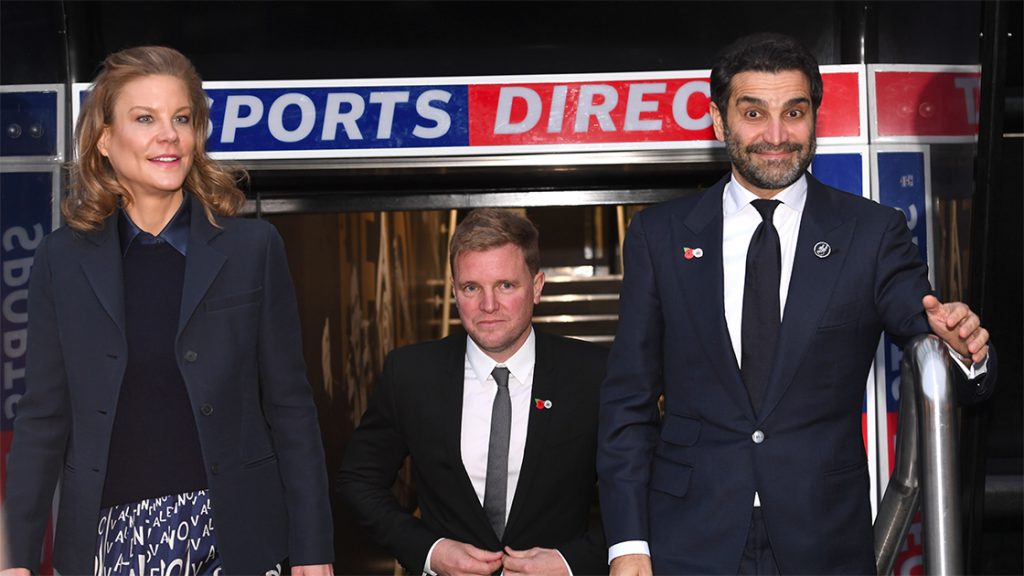
When our chief coach took the job just over four years ago we were in the clarts. Years of apparently low-risk, negative tactics under his immediate predecessor had brought little more than struggles against relegation and a lot of unwatchable football. Memorable moments, the sort of things all supporters want to witness, were few and far between.
The players were unfit for purpose, the Cabbage was just unfit and the outcome was month after month of dross. We scraped enough draws and wins to keep afloat but the lack of ambition was painfully obvious.
We were not a team in transition, we were a team and a club in decline. A third relegation under the ownership of the same unpleasant character looked inevitable until the Saudi Arabia PIF bought him out and installed Howe.
By the end of that 2021-22 season we were a match for nearly all our rivals: solid at the back, forceful in midfield and with a cutting edge. The phrase “intensity is our identity” was not just a snappy slogan. We became what it said on the can. High-risk football earned a high reward, the club’s first domestic trophy in 70 years.
One problem with shunning Pep-ball in favour of a more aggressive approach is the strain it imposes on the players, especially if they are competing on multiple fronts twice a week for months on end.
The style Howe favours is mentally and physically draining compared with possession-based tactics. The chances of scoring are higher but so is the risk of losing the ball and the risk of conceding. Opponents cannot be dominated from start to finish of a match that often lasts more than 95 minutes. Even the fittest players will, metaphorically and literally, need to catch their breath occasionally.
All of this brings us to the thorny topic of game management. Call it time wasting, call it the dark arts, call it whatever, but game management is better suited to Pep-ball than to teams that employ a more adventurous approach.
This season we have conceded late, late goals against Liverpool, Arsenal, Brighton, West Ham and Spurs. A lot of points have been dropped from winning positions.
The players are accused of sitting back whenever they take the lead, of failing to press home their advantage. This accusation conveniently ignores the reason for this almost inevitable scenario: when opponents go behind, they immediately respond.
Spurs
Against Tottenham on Tuesday night, Thomas Frank threw a centre-back into the forwards once Bruno G broke the deadlock. Cristian Romero equalised not once but twice. Just before his stoppage-time strike, Fabian Schar replaced Lewis Miley. It looked a sensible decision to counteract a potential overload in our defensive third.
If Romero had not shinned in that overhead kick and we had registered our third successive Premier League win, who would have said it was an unwise subsitution? “Success has many parents, failure is an orphan” is a phrase JFK (no, not Joe Kinnear) quoted when the Bay of Pigs crisis broke in 1962.
We can all be wise in hindsight. When he went in search of a winning goal against AC Milan in what turned out to be the final match of our Champions League campaign two years ago, the world and his wife lined up to say we had been too gung-ho, that Howe lacked tactical nous, that a more seasoned European team would have held on after taking the lead. Again, the critics conveniently ignored the ability and desire of our legendary opponents.
If we take the lead, then try to score again, who is to blame when we concede an equaliser? Is attack the best form of defence? Should we switch to Pep-ball once we are ahead? These are impossible questions to answer, because every game is different, every opposing team offer unique challenges.
What I can say is that with Tino Livramento and Lewis Hall surging forward at every opportunity to support their attack-focused teammates, there will inevitably be more bumps in the road. Even the best players cannot be in two places at one time, although Sandro Tonali does a pretty good impression of being everywhere at once.
I for one would much rather be on a high-risk journey than on the road to nowhere we travelled for a decade and more until late 2021. An expansive approach is sometimes an expensive one.
Next week I’m off to Leverkusen. No prospect of a ticket, no likelihood of entering the BayArena but every chance of having a bit of fun with the like-minded friends I last saw at Wembley nine months ago. One point would be good, three would be brilliant and all but guarantee at least 10 matches in this season’s Champions League.
Dream big and keep the faith.
If you would like to feature on The Mag, submit your article to contribute@themag.co.uk